Big Data in Occupational Risk Prevention: How Data is Revolutionizing Workplace Safety


Big Data in prevention is changing how companies protect their workforce. In today’s digital environment, where everything generates data and every action can be measured, Occupational health and safety (OHS) is undergoing a revolution. We are moving from traditional prevention to intelligent prevention and Big Data is playing a central role in this transformation. Read more on the Sabentis blog.
What is Big Data in prevention (applied to OHS)?
Big Data refers to the capture, storage, and analysis of large volumes of data — structured and unstructured — that traditional systems could not efficiently process. In large enterprises this turns data into the nervous system of the OHS management system.
In the field of Occupational health and safety (OHS), this means:
Turning it into alerts, dashboards, and decisions that allow action before an incident occurs.
Collecting data from multiple sources: inspections, accidents, training, environmental sensors, and work habits.
Analyzing that data to discover hidden patterns, trends, or critical points.
Key advantages of using Big Data in prevention
1. Real anticipation of risks
Through historical and real-time analysis, it is possible to predict where failures or incidents might occur before they happen. This is exactly how AI anticipates accidents.
2. Risk segmentation and prioritization
Not all risks are the same. Big Data allows filtering by area, task type, worker profile, or environment, so resources can be directed where they have the greatest impact.
3. Resource optimization
By prioritizing preventive actions based on data, organizations can focus investments, training, and controls more efficiently.
4. Improved regulatory compliance
Automatic reports, historical data, and indicators help demonstrate during audits that preventive management is proactive and evidence-based.
5. A shift in mindset: from reactive to proactive
We move from “an accident occurred — let’s see what failed” to “this data suggests a potential risk — let’s mitigate it first.”
A cultural transformation that is central to Sabentis’ approach. This mindset is also key to spotting near misses before they become tragedies.
Practical examples: how it applies day to day
- A company detects that during hot periods, incidents increase in a production line. By analyzing climate data + production + previous accidents, it introduces more breaks, hydration, and pace control, preventing accidents.
- Using IoT sensors connected to the workstation, variables like noise, vibration, and temperature are recorded. The analytics module detects abnormal levels and generates an automatic alert for review.
- Data on training, absenteeism, and medical exams are cross-referenced, revealing a higher rate of musculoskeletal injuries in one department. Based on this insight, a tailored ergonomic plan is implemented.
These kinds of applications are supported by studies showing that Big Data allows early identification of trends and the ability to act before risks materialize.
How Sabentis turns data into decisions
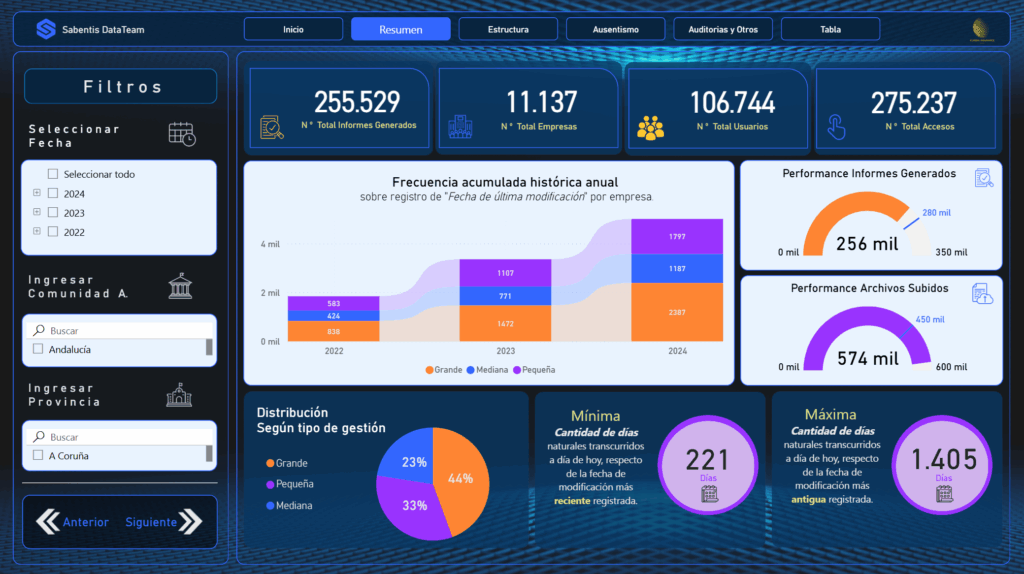
The Sabentis platform doesn’t just collect data — it turns it into value. Here’s how: One result is a smart risk map powered by business intelligence.
- BI (Business Intelligence) module: Centralizes all OHS indicators — accidents, inspections, training, occupational health — in customizable visual dashboards.
- Alerts and automation: When data shows a deviation (for example: rising incident trends, repeated causes, or training failures), Sabentis generates automatic alerts for the prevention team.
- Advanced analytics: With filters, segmentation, and comparisons across sites, countries, or business units, it helps “see what was previously invisible.”
- Integrated action: Viewing data is not enough — Sabentis links insight to action. From the dashboard, users can launch an inspection, a training session, or an ergonomic evaluation, closing the prevention loop.
- Exportable reports: For management, for audits, or to demonstrate regulatory compliance and a strategic vision of occupational safety and health.
The future of OHS is no longer reactive — it’s predictive, data-driven, and action-oriented.
With Big Data at its core, organizations can get ahead of risks, optimize resources, and transform their safety culture.
And with Sabentis, that vision stops being a dream and becomes a reality.
👉 Are you ready to let your data work for you?
Request a demo of Sabentis BI today and discover how to move from traditional prevention to intelligent prevention.
✅ Want to see how your company can turn its data into safer decisions?
👉 Request a demo Data-driven prevention aligns with the risk-based approach of the ISO 45001 standard.